Showing posts with label deep sea. Show all posts

Thursday, October 22, 2020

Fishes and Fishes

 Have been pretty busy with my day job, but I have also been drawing many patterns and fishes.

Everything pops up here (my Master Site) and on my Spoonflower Site.

First, I answered several requests in spoonflower for peacock bass, marlin and tuna patterns.  All posted on spoonflower.

Then I add some odd abstract patterns of loops and tuna and trevally, the kind that look good on shirts, curtains, and sheets. 

As far as new fish, I have been looking for the interesting and fishes that I have yet to draw so drew up:

Lookdowns, which have an interesting profile, and like to hang around reefs, bridges, and piers. A jack family fish.

Kob, which are huge saltwater gamefish of bays and estuaries from South Africa related to White Sea Bass, Weakfish,  Blackspot Croaker, and Spotted Seatrout.

Scrawled Butterflyfish, which are pretty reef fish just like the other butterflyfish.

Leaping Bonito, a colorful fast saltwater fish between tuna and mackerel, found around Australia.



Thursday, July 30, 2020

Sharks and Tuna Weeks

Sharks and Tuna Weeks~!
Answered a bunch of requests, including the very colorful laurel dace, and added several scatter patterns of plankton, tunas, offshore and reef fish, and of course, sharks, including offshore sharks, and deep sea sharks!

tight lines, calm seas, and BE SAFE!
Bryce

Monday, June 8, 2020

Odd fishes and Plankton

Odd fishes and Plankton


Plankton are microscopic organisms that form the base of the ocean, lake, and river food chains.  There are two big categories: Phytoplankton which are the photosynthetic things, and the zooplankton, which are the things that eat the light using phytoplankton.   I started drawing a few interesting types of zooplankton, and they are now in the pile (awaiting spoonflower push, but in cafepress, etc.):

  • Two copepods so far.  Copepods are crustaceans related distantly to shrimp. 
  • Another odd crustacean: Cystisoma Hyperiid
    • Giant eyes and looks more like a cross between a fly and a shrimp
  • A microscopic deep worm: Tomopteris Polychaete
  • A sea slug we saw on a research trip to Panama City Beach a decade ago: a Nudibranch  
  • More will follow
Also added a fish that I like to catch in the Mississippi river on a fly rod: the Skipjack (Shad) Herring. Jumps like a tarpon, and is food for many large predatory fish.

Also will be adding more European saltwater fishes, and did add the John Dory (Zeus, St. Peters) Fish. It is definitely a time consuming draw, but worth it. 

Tight lines, calm seas, and be careful with your eyepieces!

Bryce

Thursday, May 14, 2020

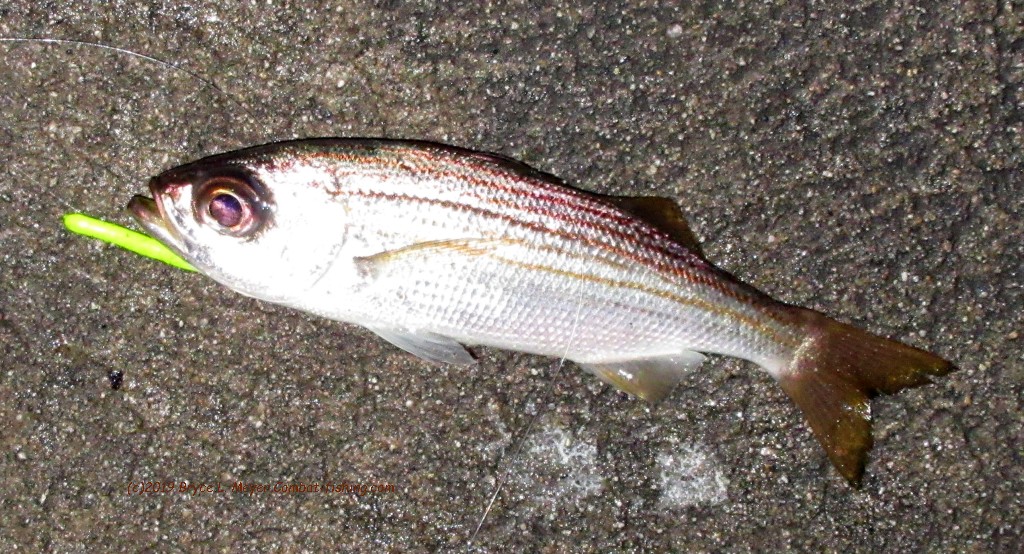
Cute little ignored fishy: Salema

The Salema grunt(Xenistius californiensis)

(for a real picture: http://www.combat-fishing.com/Salema1BelomntShoresPierPacificOceanCA06Nov2019wra.jpg )

In addition to my continuing shark updates for the deep sea sharks (updated the frilled shark...what an odd beastie to be sure! and added the smoothhound shark too, and fixed the sixgill shark and sevengill shark) I added a cute little fish that one sees when fishing light under the lights of SoCal bay piers (Belmont Veterans pier is a perfect example) : the Salema (grunt) (Xenistius californiensis). It is a yellow-orange striped fish that looks like a white bass, yellow bass (which is of the same size range too) or baby striped bass that got dipped in colorful paints.  Like many cases in nature its looks are due to convergent evolution, i.e. even though the Salema is a grunt, and the yellow bass is a temperate bass, they are both schooling fish that eat small invertebrates and small fishes.  Not to be confused with the Mediterranean Salema (a porgy, that looks like a pinfish which is also a porgy). Interesting ly enough, you could theoretically catch the deep sea sharks mentioned above and the little Salema on the same pier, but likely not on the same tackle!

Tight lines and calm seas,
Bryce

Saturday, March 28, 2020

More odd fishes and cool stuff


Deep sea fish are often 'red' fish, in that they have red, orange, and purple coloration, since red is the first color to get stopped by water...at depth these fish are close to black, but on the surface or in the shallows a cool array of sunset colors. 

First I added two Cardinal fish...popular aquarium fish all over. 
The  Banggai cardinalfish is a popular aquarium fish but int he wild has a very limited range, on reefs around the Banggai Islands in Indonesia.  It is not red, but just interesting in general.
A relative is more orange, the Pajama or Spotted Cardinalfish (fyi, they don't look like the bird or the churchman, wonder if they are important in something?), which  has some orange on the fins.

A redder fish family is the Squirrelfish (big eyes = squirrel-like maybe?), which have scales and stripes, and are again a popular saltwater reef fish family.  Drew two common types: Squirrelfish of the Atlantic, and the Hawaiian Squirrelfish of the Pacific.  The Hawaiian model, like the Hawaiian shirt is a bit more colorful.

I also added the deep water Queen Snapper, a purplish-reddish-Atlantic fish caught in water from a few hundred to thousand feet deep.

The same fishes are on patterns and decor also at my Spoonflower site (or soon will be).

Tight lines, calm seas, and BE SAFE!

Bryce L. Meyer


Monday, February 24, 2020

More butterflyfish

More Butterflyfish drawings!


Drew up two similar butterflyfish: Chevron and Atoll.

Chevron butterflyfish (Chaetodon trifascialis) is a saltwater reef fish of the Indian and Pacific oceans including the Red Sea, and has lots of arrow marks (like sergeant stripes sideways).

A close relative, same genus is the Atoll Butterflyfish (Chaetodon mertensii)  hangs out on tropical Pacific Reefs.
Note the similar species to the Atoll Butterflyfish: Chaetodon madagascariensis  Indian Ocean, Chaetodon xanthurus , and Chaetodon paucifasciatus Red Sea.  Making something a species versus just a population is a big deal in the fishery biologist community, and can spark heated debate if the animals in question all look the same. Whole careers for some hinge on finding a species, and if you want to watch college professors yell at each other, ask them to prove their favorite is actually a species. 

Look for a whole pile of other fishes, including groupers, in my spoonflower site soon too. 

Tight Lines and Calm Seas,
Bryce